Why Deals Keep Slipping Through Your Pipeline (And What Sales Stages Have To Do With It)
Jul 03, 2026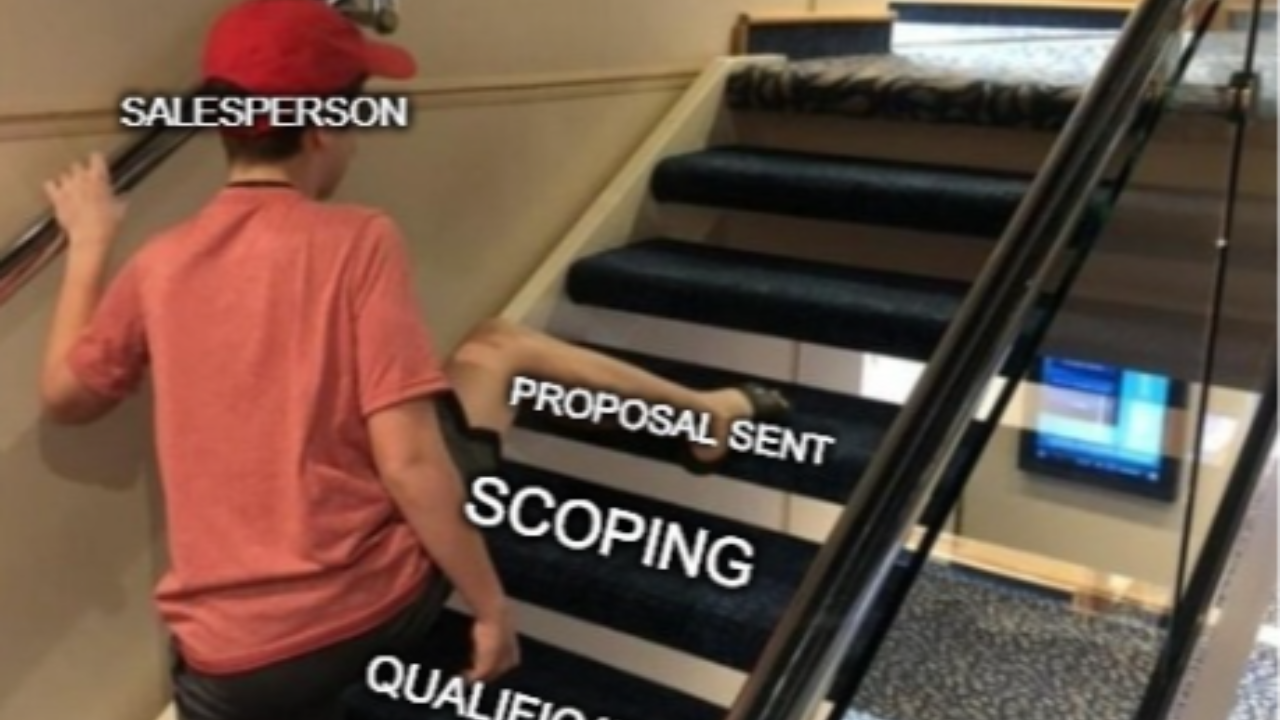
Sales Stages Should Measure Buyer Progress, Not Seller Activity
One of the most common reasons revenue becomes difficult to predict is that sales stages are built around seller activity rather than buyer progress.
Many CRM pipelines are full of stages such as:
- Discovery Complete
- Demo Delivered
- Proposal Sent
- Follow Up Scheduled
At first glance these stages appear logical. They describe what happened during the sales process and give sales teams a structure to follow.
The problem is that they tell us very little about whether the customer is actually moving towards a purchasing decision.
A demo can be delivered to someone with no authority to buy.
A proposal can be sent to a prospect who has no budget.
A follow-up meeting can be scheduled simply because the prospect is being polite.
Seller activity creates the appearance of progress. Buyer progress creates revenue.
The Difference Between Activity and Progress
Consider two opportunities.
In the first opportunity, the account executive has completed a discovery call, delivered a product demonstration and sent a proposal.
In the second opportunity, the customer has confirmed a business problem, identified an internal owner, agreed a target timeline and committed to a next step involving multiple stakeholders.
Many organisations would place the first opportunity further through the pipeline because more seller activity has occurred.
In reality, the second opportunity is often much more likely to close.
The distinction matters because forecasting depends on understanding buyer commitment, not seller effort.
Why Activity-Based Stages Create Forecasting Problems
When stages are based on seller actions, opportunities can advance through the pipeline regardless of whether meaningful progress has occurred.
This creates three common problems.
First, pipeline value becomes inflated. Opportunities move forward because activities were completed rather than because evidence of buyer commitment exists.
Second, forecast accuracy declines. Opportunities appear healthy inside the CRM despite lacking the conditions required to become revenue.
Third, conversion analysis becomes unreliable. Leadership cannot identify where deals are truly stalling because stages are measuring internal activity instead of customer progression.
The result is a pipeline that looks active but produces inconsistent outcomes.
What Buyer Progress Looks Like
A well-designed sales stage should represent a meaningful change in the customer's buying journey.
Instead of asking:
"What did the salesperson do?"
Ask:
"What evidence do we have that the buyer has moved forward?"
Examples might include:
- The customer has confirmed a business problem worth solving.
- A responsible stakeholder has been identified.
- Budget availability has been discussed.
- A decision-making process has been understood.
- A target implementation date has been agreed.
- Procurement or legal review has been initiated.
Each stage should represent a higher level of buyer commitment than the previous one.
This creates a much stronger relationship between stage progression and eventual revenue outcomes.
Exit Criteria Create Consistency
The most effective sales organisations define clear exit criteria for every stage.
Exit criteria establish the evidence required before an opportunity can progress.
For example, moving from qualification into validation may require evidence that:
- A business problem exists.
- An accountable person has been identified.
- A customer deadline has been established.
- The information was obtained from a credible source.
Without this evidence, the opportunity remains in its current stage.
This creates consistency across the team and allows opportunities to be compared on a common basis.
As organisations mature, this discipline becomes essential because revenue predictability depends on applying the same standards across every opportunity.
Better Stages Lead to Better Decisions
When sales stages reflect buyer progress, several things happen.
Forecasts become more accurate because stage advancement is linked to genuine customer commitment.
Pipeline reviews become more objective because opportunities are evaluated using evidence rather than optimism.
Sales coaching becomes more effective because leaders can identify exactly where buyers are becoming stuck.
Most importantly, teams develop a clearer understanding of how successful opportunities progress from initial conversation to closed business.
Final Thoughts
A sales process should not measure how busy a salesperson has been.
It should measure how close a customer is to making a decision.
When stages are built around activities, forecasting becomes vulnerable to opinion and interpretation.
When stages are built around buyer progress and supported by clear exit criteria, the pipeline becomes more measurable, more coachable and significantly more predictable.
If your forecast regularly misses despite strong levels of activity, the problem may not be effort.
It may be that your sales stages are measuring the wrong thing.